WTV means “whatever” in text messages and online conversations. It is a casual texting abbreviation used to show indifference, flexibility, or a desire to move past a topic. Depending on context, wtv can sound relaxed, playful, dismissive, or slightly annoyed.
Key Takeawaysinternet slang
- WTV = “whatever.”
- It is an informal texting abbreviation and internet slang term.
- It can mean “I don’t mind,” “it’s up to you,” “I don’t care,” or “let’s drop it.”
- The tone depends heavily on the surrounding conversation, punctuation, and emojis.
- A standalone “wtv” can sound more dismissive than “wtv 😂” or “wtv, you choose.”
- It is best suited to casual messages, DMs, group chats, and social media rather than professional writing.
WTV Meaning in Text
The main wtv meaning in text is “whatever.” It is a shortened form of the word that people use when typing casually and want to keep a message brief.
Depending on the situation, wtv may communicate several closely related ideas:
- “Whatever”
- “I don’t mind”
- “It’s up to you”
- “I don’t care”
- “Any option is fine”
- “Do what you want”
- “Let’s stop talking about it”
For example:
“What movie should we watch?”
“Wtv, you pick.”
Here, wtv is relaxed and means the person has no strong preference.
But:
“You never listen to me.”
“Wtv.”
In this context, it may sound dismissive or irritated.
That difference is important. The abbreviation itself does not automatically indicate anger, sarcasm, or a particular emotion. The surrounding conversation gives it its tone.
What Does WTV Stand For?
WTV stands for “whatever.”
It is better described as a texting abbreviation or internet-slang shorthand than a formal acronym. People generally use the letters to represent the spoken word “whatever” in informal digital communication.
You may see it written as wtv, WTV, or Wtv. Capitalization usually does not change the intended meaning.
How Is WTV Used?
WTV is mainly used in informal online communication where short, quick messages are natural.

Text Messages
Someone might use WTV when they do not have a preference:
“Pizza or burgers?”
“Wtv, both are good.”
DMs
In a direct message, WTV can make a response shorter:
“You wanna go tonight or tomorrow?”
“Wtv works for me.”
Group Chats
In group conversations, it can mean the sender is leaving the decision to everyone else:
“Where are we meeting?”
“Wtv you guys decide.”
Social Media Comments
WTV can also appear in casual comments or replies when someone wants to express indifference or brush off a topic.
Gaming Chats
In casual gaming conversations, someone might use WTV to show that they are flexible about what happens next:
“Ranked or casual?”
“Wtv, I’m down.”
The important point is that wtv belongs to informal communication. It is not normally appropriate for formal documents, professional emails, or other situations where standard language is expected.
WTV in Different Contexts
The same three letters can communicate different shades of meaning depending on the conversation.
From a Friend
A friend saying:
“Wtv, you choose.”
usually means they are letting you decide.
If they say:
“Wtv. I’m done talking about this.”
the tone is much more dismissive.
From a Guy
If a guy texts “wtv,” the abbreviation itself does not reveal whether he is interested, annoyed, joking, or uninterested.
Look at the messages before and after it. His wording, punctuation, emojis, and the topic of conversation provide more useful context than the abbreviation alone.
From a Girl
The same applies when a girl sends “wtv.” The meaning does not automatically change based on gender.
For example:
“Wtv 😂 you decide.”
may sound playful, while:
“Wtv. Forget it.”
may sound frustrated or dismissive.
From a Crush
If your crush sends “wtv,” do not automatically interpret it as flirting, rejection, or loss of interest.
The meaning depends on the conversation. A response such as “wtv, you pick 😂” can simply show flexibility, while a short “wtv” during an argument may signal that they do not want to continue the discussion.
In Dating
In dating conversations, WTV can mean:
- “Whatever works for you.”
- “You choose.”
- “I don’t have a preference.”
- “I don’t want to argue about this.”
Its romantic meaning cannot be determined from the abbreviation alone.
In a Relationship
Partners may use WTV casually, but it can also sound dismissive during conflict.
“Do you want to talk about what happened?”
“Wtv.”
That response may suggest the person does not want to continue the discussion, but the broader conversation is needed to understand why.
In a Group Chat
A group chat, wtv often works as a quick way to let others make the decision:
“Dinner at 6 or 7?”
“Wtv, 7 is fine.”
Social Media Comments
In comments, WTV may be used as a quick reaction meaning “whatever” or “I don’t really care.” The surrounding comment thread can determine whether it sounds playful or dismissive.
Real Chat Examples
Here are realistic ways WTV can appear in everyday conversations:
- “What do you wanna eat?”
“Wtv, you choose.” - “Movie tonight?”
“Wtv works for me.” - “Should we leave at 6 or 7?”
“Wtv, I’m free.” - “Pizza or tacos?”
“Wtv 😂” - “Do you want the blue one or black one?”
“Wtv, they both look good.” - “Are you coming with us?”
“Wtv, I might.” - “You always do this.”
“Wtv.” - “I’m not arguing about this anymore.”
“Wtv.” - “Where should we meet?”
“Wtv you guys want.” - “Do you want to watch a comedy?”
“Wtv, I’m good with anything.” - “You picked the restaurant last time.”
“Wtv, pick this time.” - “Are you mad at me?”
“Wtv, it’s fine.” - “Should I call you later?”
“Wtv works.” - “Which game should we play?”
“Wtv, you decide.” - “Do you still want to go?”
“Wtv, I don’t really care.” - “You could’ve told me earlier.”
“Wtv, it’s done now.” - “Coffee or tea?”
“Wtv ☕” - “Do you want to sit inside or outside?”
“Wtv, either is fine.” - “Are we doing this today?”
“Wtv, I’m free.” - “Why are you ignoring me?”
“Wtv, I’m not getting into this.”
These examples show why context matters. WTV can be flexible and harmless in one message but dismissive in another.
How to Reply to WTV
Your best response depends on what the sender appears to mean.
Casual Replies
- “Okay, you pick then.”
- “Sounds good.”
- “Either works for me too.”
- “Cool, let’s do that.”
Friendly Replies
- “Haha, I’ll choose then.”
- “You’re really leaving it up to me 😂”
- “Fine, I’ve got a plan.”
- “Works for me.”
Funny Replies
- “Wow, such a strong opinion 😂”
- “WTV is not a decision, pick one.”
- “I’m taking that as a vote for pizza.”
- “Okay, captain whatever 😂”
Neutral Replies
- “Sure, what works best for you?”
- “No problem.”
- “Okay, just let me know.”
- “Got it.”
Flirty/Relationship Replies
When the conversation is already romantic, you can keep the response playful:
- “You just want me to choose, don’t you?”
- “WTV? I think you secretly have a preference.”
- “Fine, but you’re coming with me.”
- “I’ll choose if you promise not to complain.”
Avoid treating wtv itself as proof of romantic interest. The surrounding conversation matters more.
What Tone Does WTV Have?
WTV is context-dependent. Common tones include:
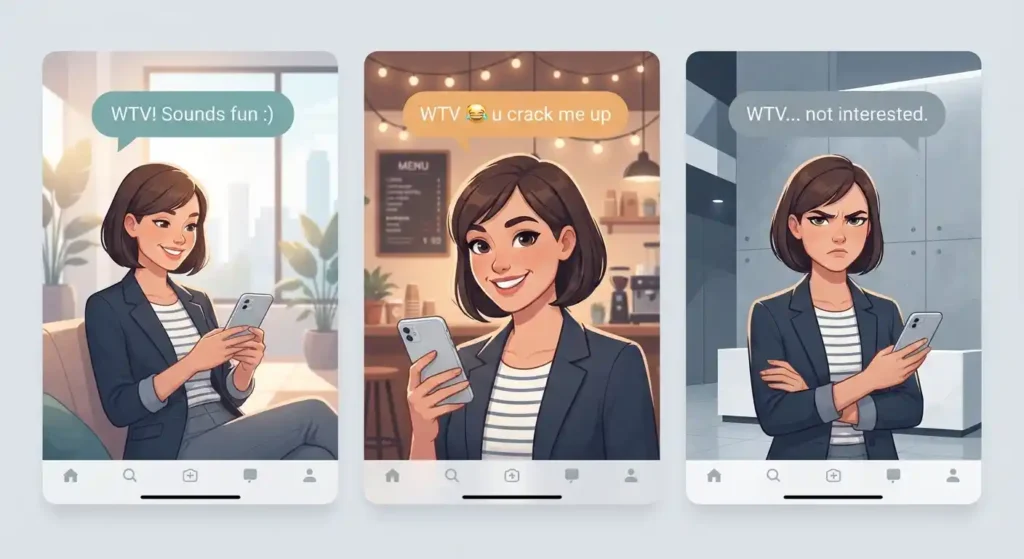
- Casual: “Wtv, either one is fine.”
- Flexible: “Wtv you want.”
- Playful: “Wtv 😂”
- Neutral: “Wtv works.”
- Dismissive: “Wtv. I’m done.”
- Slightly annoyed: “Wtv, forget it.”
Punctuation can also affect how the message feels. A standalone “WTV.” may feel more abrupt than “wtv 😂” or “wtv, you decide.”
Emojis, previous messages, and the relationship between the people can all change how the same abbreviation is interpreted.
Is WTV Rude or Offensive?
WTV is not inherently rude or offensive. It is informal slang, but it can sound rude when used as a blunt response during a disagreement.
For example:
“What do you want to do?”
“Wtv.”
This may simply mean the person does not care.
But:
“Can we talk about what happened?”
“Wtv.”
can sound dismissive because of the emotional context.
Casual Conversations
WTV is generally suitable for informal conversations with friends or people who understand texting shorthand.
Social Media
It can fit casual comments, DMs, and other informal online communication.
School
It may be fine in a casual message to a friend, but standard wording is better for assignments or formal communication.
Work
Avoid WTV in professional messages unless you are certain the communication is extremely casual. Writing “whatever,” “either is fine,” or “I’m flexible” is clearer and more professional.
Formal Writing
WTV is not appropriate for formal writing. Use the complete word or a clearer phrase instead.
Other Meanings of WTV
In the context of texting and internet slang, the relevant meaning is “whatever.”
The letters WTV can appear as an abbreviation or acronym in specialized fields, but those meanings are separate from the texting shorthand. If you encounter WTV in a technical, organizational, or industry-specific document, use the surrounding subject matter to determine what it represents rather than automatically assuming it means “whatever.”
For an ordinary text, DM, or casual online conversation, “whatever” is the natural interpretation.
Common Mistakes About WTV
Assuming WTV Always Means “I Don’t Care”
Sometimes it means “I don’t care,” but not always. “Wtv you want” can simply mean the sender is happy for you to choose.
Assuming WTV Means Someone Is Angry
A standalone WTV can sound cold, but the abbreviation does not prove anger. Look at the conversation before making that judgment.
Assuming WTV Is Flirty
WTV does not inherently have a romantic or flirty meaning. Any romantic interpretation comes from the broader conversation.
Treating WTV as Formal Language
WTV is casual shorthand. It should not normally replace standard language in professional or formal communication.
Ignoring Punctuation and Emojis
Compare:
“wtv 😂”
with:
“WTV.”
They contain the same abbreviation, but they can create very different impressions.
WTV and Related Slang
| Term | Meaning | Common Use |
|---|---|---|
| WTV | Whatever | Indifference, flexibility, or dismissal |
| IDC | I don’t care | Directly expressing lack of concern |
| W/E | Whatever | Casual shorthand for “whatever” |
| WTFR | Whatever | Informal variation used in some chats |
| NVM | Never mind | Dropping or withdrawing a previous point |
| IDK | I don’t know | Uncertainty or lack of information |
These terms are not interchangeable in every situation. WTV focuses on “whatever,” while IDC more directly says the sender does not care, and NVM usually signals that the sender wants to drop a previous thought or question.
People Also Ask About WTV
What does WTV mean in a text message?
WTV usually means “whatever.” It is an informal abbreviation used to express indifference, flexibility, or dismissal depending on the context.
Does WTV mean “whatever you want”?
It can. For example, “WTV you want” can mean “whatever you want,” but WTV by itself simply means “whatever.”
Is WTV rude?
Not necessarily. It can be perfectly casual, but a short “wtv” during an argument may sound dismissive or annoyed.
Does WTV mean someone is mad?
No. WTV does not automatically mean someone is angry. Their previous messages, wording, punctuation, and the subject of the conversation provide better clues.
What does WTV mean from a crush?
It still means “whatever.” The abbreviation alone does not show whether your crush is flirting, uninterested, annoyed, or simply letting you choose.
Is WTV the same as IDC?
They can overlap, but they are not exactly the same. IDC directly means “I don’t care,” while WTV can also mean “whatever,” “either is fine,” or “you decide.”
Can I use WTV at work?
It is better to avoid it in professional communication. Use clearer phrases such as “either works for me,” “I’m flexible,” or “whichever you prefer.”
Conclusion
WTV means “whatever” in text and online slang. It is an informal abbreviation used to express flexibility, indifference, or dismissal. The tone can be casual, playful, neutral, or slightly annoyed depending on the conversation.
The safest way to interpret WTV is to consider the context, previous messages, punctuation, emojis, and relationship between the people involved. In casual chats it can be perfectly harmless, while in an argument it may sound dismissive. For professional or formal communication, spelling out the intended meaning is a better choice.

Mila Parker brings three years of writing experience to the craft of puns, jokes, and concise wordplay. Her subject range moves through food, animals, seasonal themes, technology, entertainment, and trending topics. She studies relevant terminology, connects words through double meanings and associations, then adjusts setups and punchlines to keep each joke clear and well structured.