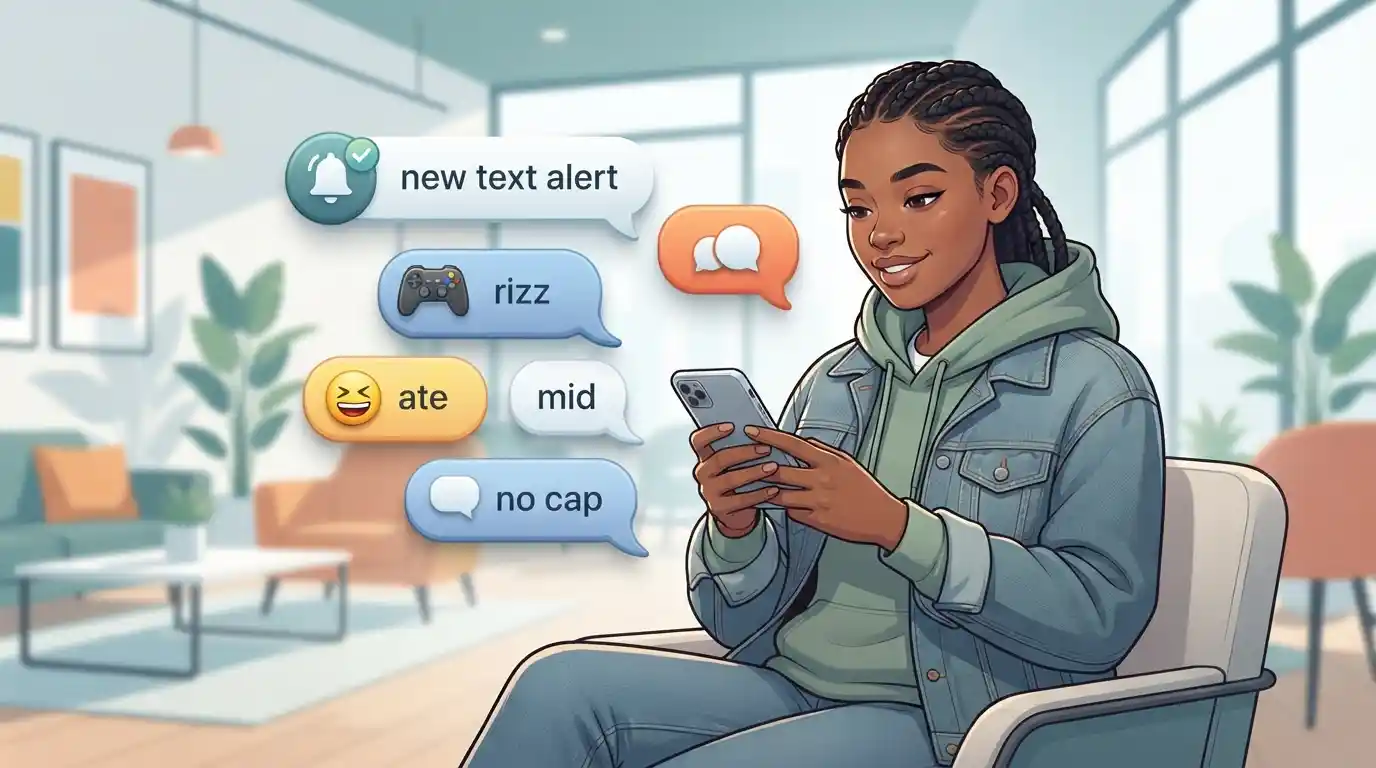
Gen-Z slang refers to informal words, phrases, and expressions associated with Generation Z, especially language used in texting, social media, memes, gaming, and casual conversation. It is a broad category, not one specific slang word or acronym.
Key Takeaways
- Gen-Z slang means casual language associated with Gen Z and internet culture.
- It is not a full-form acronym; “Gen Z” refers to Generation Z, while “slang” describes informal language.
- Common examples include rizz, no cap, aura, cooked, delulu, mid, ate, and sus.
- Meaning often depends on context, tone, emojis, and the conversation rather than the word alone.
- Much of this vocabulary spreads through social media, gaming, memes, music, and online communities.
- Some expressions associated with Gen Z originated in or were influenced by older slang and specific cultural communities, so they are not necessarily newly invented by Gen Z.
Gen-Z Slang Meaning in Text
In text messages, Gen-Z slang means the informal vocabulary, expressions, abbreviations, and phrases commonly associated with contemporary Gen Z and online communication.
It can describe anything from a single word such as “mid” to a phrase such as “main character energy.” These expressions can communicate approval, disbelief, humor, criticism, confidence, attraction, embarrassment, or other social reactions quickly.
Gen-Z slang is best understood as a category of language, rather than a fixed dictionary of words. Its vocabulary changes over time, and a term that feels current in one online community may sound dated, ironic, or unfamiliar in another.
What does Gen-Z mean?
Gen Z is short for Generation Z, the generational label commonly used for people born after Millennials and before Generation Alpha. The exact birth-year boundaries vary depending on the source.
“Gen-Z slang” therefore means slang associated with that generation. The phrase itself is not slang in the same way that words such as “rizz” or “delulu” are.
Is Gen-Z slang the same as internet slang?
Not exactly.
There is significant overlap between Gen-Z slang and internet slang, but they are not interchangeable. Internet slang is a broader category that can include expressions used across multiple generations and online communities.
Gen-Z slang is more specifically associated with language and cultural trends connected with Gen Z.
What Does Gen-Z Slang Stand For?
Gen-Z slang does not have a traditional full form.
“Gen Z” is the shortened form of Generation Z, while “slang” means informal language used in particular social groups or situations.
So:
- Gen Z = Generation Z
- Slang = informal words and expressions
- Gen-Z slang = informal language associated with Gen Z
It is therefore more accurate to call Gen-Z slang a category of informal language than an acronym or texting abbreviation.
How Is Gen-Z Slang Used?
Gen-Z slang can appear in several types of casual communication.
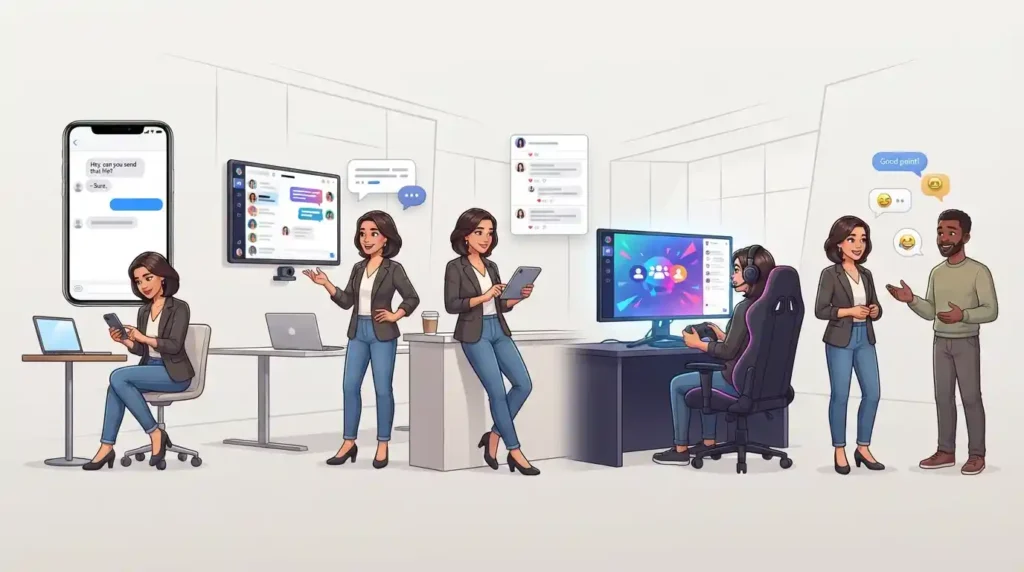
Text Messages
Friends may use slang to make messages shorter, more expressive, humorous, or conversational.
“That outfit ate.”
“No cap, that movie was mid.”
Group Chats
Group conversations often contain slang alongside memes, inside jokes, reaction phrases, and abbreviations.
“Bro is cooked 💀”
Social Media
TikTok, Instagram, YouTube, and other social platforms can help slang spread rapidly through captions, comments, videos, and memes.
“The comments are sending me.”
Gaming
Gaming communities contribute terms that can move beyond games and become part of broader online vocabulary.
“We’re cooked.”
“He’s the final boss.”
Everyday Conversation
Some internet expressions eventually appear in spoken conversations, especially among people who already encounter them online.
The important distinction is that seeing a word online does not automatically make it exclusively Gen Z slang. Language frequently moves between generations and communities.
Gen-Z Slang in Different Contexts
The meaning and tone of slang can change depending on who uses it and what is happening in the conversation.
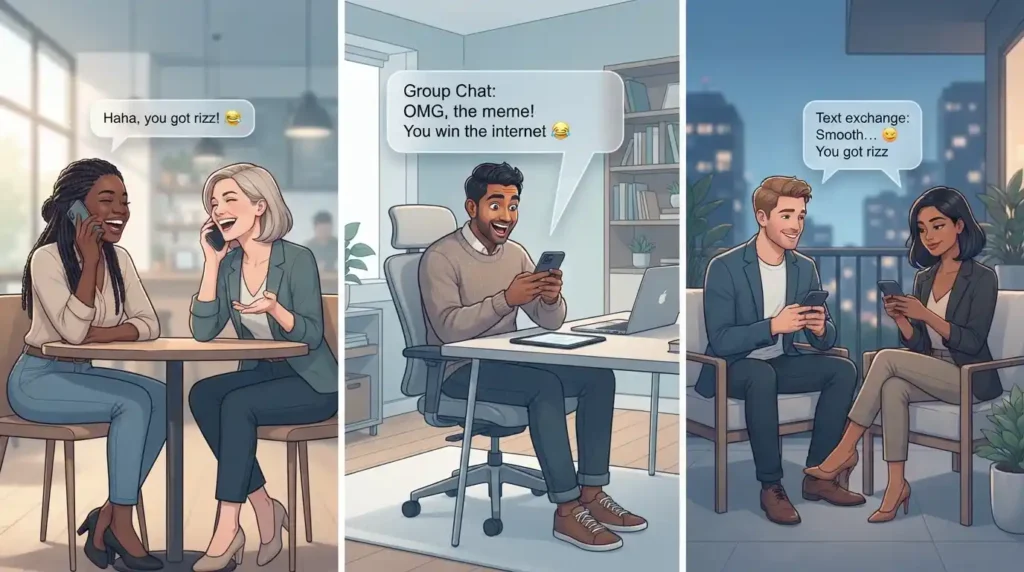
From a Friend
A friend might use slang casually:
“That restaurant was actually bussin.”
Here, the speaker is expressing strong approval.
In a Group Chat
Slang may become more exaggerated or humorous:
“I just sent that email to the wrong person. I’m cooked.”
“Cooked” can humorously mean that someone is in trouble or facing a difficult situation.
In Social Media Comments
A short expression can function almost like a reaction:
“Ate.”
This can mean that someone performed exceptionally well or looked great.
In Dating
Some Gen-Z slang has dating-related uses.
For example, “rizz” refers to charm or the ability to attract someone, particularly in a romantic context.
“He has serious rizz.”
That does not automatically mean the speaker is romantically interested in the person being discussed. The surrounding conversation matters.
From a Crush
Slang alone cannot prove romantic interest.
A message such as:
“You got rizz 😂”
could be playful teasing, a compliment, or flirting depending on the relationship and the rest of the conversation.
Look at the previous messages, wording, punctuation, emojis, relationship, and topic before interpreting the intent.
In a Relationship
Partners may use slang simply as part of their normal communication.
“You ate that outfit.”
The expression can be affectionate without having a special hidden meaning.
Real Chat Examples
Here are realistic examples showing how Gen-Z slang can appear in everyday conversations:
- Friend: “Are you coming tonight?”
Reply: “Bet.” - Friend: “This burger is actually bussin.”
- Friend: “No cap, that was the funniest thing ever.”
- Friend: “That outfit ate.”
- Friend: “He has zero rizz.”
- Friend: “Why did I agree to do all this work? I’m cooked.”
- Friend: “That movie was kinda mid.”
- Friend: “She has so much aura.”
- Friend: “That sounds sus.”
- Friend: “I’m delulu for thinking they’ll text first.”
- Friend: “Don’t sleep on that restaurant.”
- Friend: “Bro really thought he was the main character.”
- Friend: “You absolutely slayed that presentation.”
- Friend: “That comeback was wild 💀.”
- Friend: “I fear you ate.”
- Friend: “No way he actually said that.”
- Friend: “That outfit has drip.”
- Friend: “She really popped off with that speech.”
- Friend: “I have FOMO because everyone is going without me.”
- Friend: “That whole situation is giving chaos.”
- Friend: “He’s acting like an NPC today.”
- Friend: “I’m lowkey obsessed with this song.”
- Friend: “That was highkey impressive.”
- Friend: “You’re sleeping on this show.”
- Friend: “The group chat has officially lost the plot.”
These examples show why context matters: the same slang can be complimentary, sarcastic, humorous, dismissive, or simply descriptive.
How to Reply to Gen-Z Slang
There is no single reply to Gen-Z slang because the appropriate response depends on the expression being used.
Casual Replies
- “Bet.”
- “Facts.”
- “For real.”
- “I get you.”
- “Honestly, same.”
- “That’s fair.”
Friendly Replies
- “Lmao, exactly.”
- “You’re not wrong.”
- “I was thinking the same thing.”
- “That’s actually hilarious.”
- “Okay, I see the vision.”
Funny Replies
- “Bro is cooked.”
- “The aura is gone.”
- “We may never recover.”
- “That’s work.”
- “I cannot defend you on this one.”
Neutral Replies
If you are unsure what the slang means, simply ask:
- “What does that mean?”
- “Wait, translate that for me.”
- “I know that’s slang, but what are you saying?”
- “What do you mean by that?”
Flirty or Relationship Replies
When the conversation is clearly romantic, you can match the tone:
- “Oh, so you’re flirting now?”
- “I’ll take that as a compliment.”
- “Careful, you’re making yourself obvious.”
- “Are you trying to impress me?”
- “Okay, smooth.”
The safest approach is to respond to the actual message and context, rather than assuming slang automatically signals attraction.
What Tone Does Gen-Z Slang Have?
Gen-Z slang does not have one fixed tone.
Depending on the expression, it can be:
- Casual — used in everyday conversations
- Playful — used for jokes and teasing
- Humorous — especially in memes and group chats
- Sarcastic — when the literal meaning is intentionally exaggerated
- Positive — for praise or approval
- Negative — for criticism or rejection
- Informal — generally suited to relaxed communication
- Context-dependent — meaning changes according to the conversation
Irony is especially important with online slang. Someone may use a term sincerely, sarcastically, or simply because it has become a recognizable meme.
Is Gen-Z Slang Rude or Offensive?
Gen-Z slang is not automatically rude or offensive. Most slang is simply informal, but individual expressions can have insulting, sexual, controversial, or culturally sensitive meanings.
Casual Conversations
Gen-Z slang is generally most natural among friends and in relaxed conversations.
Social Media
It can be common in posts, comments, captions, memes, and casual online communities.
School
Whether it is appropriate depends on the setting and the particular expression. Informal slang is generally different from language expected in an academic assignment.
Work
Some slang may sound too casual for workplace communication, especially when speaking with customers, managers, or professional contacts.
Professional Writing
Avoid relying on slang in formal emails, reports, applications, contracts, and other professional documents unless the style specifically calls for informal language.
The key issue is audience and context, not simply whether a word is labeled “Gen Z.”
Other Meanings of Gen-Z Slang
There is no major alternative acronym expansion of “Gen-Z slang” that needs to be substituted for its ordinary meaning.
However, individual terms grouped under Gen-Z slang can have completely different meanings outside slang.
For example, “NPC” traditionally refers to a non-player character in video games. In online slang, it can describe someone perceived as behaving predictably or without independent thought.
Likewise, words such as aura, cooked, cap, drip, and sus have ordinary meanings or older uses that can differ from their slang meanings.
This is why the surrounding sentence matters.
Common Mistakes About Gen-Z Slang
Assuming Gen-Z Slang Is One Specific Language
It is not. Gen-Z slang is a broad category containing many different words, phrases, abbreviations, memes, and expressions.
Assuming Gen Z Invented Every Term
Not necessarily. Some expressions associated with Gen Z have roots in earlier slang or specific cultural and linguistic communities.
Assuming Every Young Person Uses the Same Slang
Generational labels are broad. People have different interests, regions, communities, friend groups, and online spaces.
Treating Slang Definitions as Permanent
Internet vocabulary can change meaning, become less common, or develop ironic uses.
Assuming Slang Proves Romantic Interest
A word such as “rizz” can relate to attraction, but its presence alone does not prove that someone is flirting.
Using Slang in Every Conversation
Knowing slang and using slang are different things. A term can sound natural in one conversation and forced in another.
Gen-Z Slang and Related Slang
| Term | Meaning | Common Use |
|---|---|---|
| Rizz | Charm or romantic appeal | Dating, flirting |
| No cap | No lie; seriously | Emphasizing truth |
| Cap | A lie or false claim | Calling out exaggeration |
| Ate | Did something extremely well | Praise |
| Aura | A person’s coolness, presence, or vibe | Social reactions |
| Cooked | In trouble, overwhelmed, or finished | Problems or failure |
| Delulu | Playfully short for delusional | Humor, goals, dating |
| Mid | Average or unimpressive | Reviews and opinions |
| Sus | Suspicious or questionable | Situations and behavior |
| Slay | Do something exceptionally well | Praise |
| Lowkey | Subtly or somewhat secretly | Opinions and feelings |
| Drip | Stylish clothing or appearance | Fashion |
| FOMO | Fear of missing out | Social situations |
These terms are not interchangeable. Their meanings depend on the sentence, community, and context.
People Also Ask About Gen-Z Slang
What is Gen-Z slang?
Gen-Z slang is a broad category of informal language associated with Generation Z. It includes words and expressions used in casual conversations, texting, social media, gaming, memes, and other online communities.
What are some examples of Gen-Z slang?
Examples include rizz, no cap, cap, aura, cooked, delulu, mid, ate, slay, sus, lowkey, and drip. The popularity and meaning of individual terms can change over time.
Is Gen-Z slang the same as texting slang?
No. There is considerable overlap, but texting slang is broader. Gen-Z slang refers specifically to language associated with Gen Z, while texting slang can include abbreviations and expressions used by people of many ages.
Where does Gen-Z slang come from?
It comes from many sources, including internet communities, gaming, music, memes, social media, earlier slang, and specific cultural communities. Terms can also be adopted, remixed, and given new meanings as they spread online.
Is Gen-Z slang appropriate at work?
It depends on the expression and workplace. Casual slang may be fine in an informal team chat, but professional emails, reports, applications, and customer-facing communication usually call for clearer and more conventional language.
Why does Gen-Z slang change so quickly?
Online communities can spread new expressions extremely quickly. Memes, short-form videos, music, gaming communities, and social-media trends can give a phrase new meanings or make it popular before another expression replaces it.
Does Gen-Z slang always have a hidden meaning?
No. A slang term can simply be a casual way of expressing an idea. Context is more reliable than assuming that a particular word automatically signals flirting, sarcasm, approval, or another specific intention.
Conclusion
Gen-Z slang is a broad category of informal language associated with Generation Z, especially in texting, social media, gaming, memes, and casual conversation. It is not an acronym with one full form.
Its meaning depends heavily on context, tone, relationship, and online community. Terms such as rizz, aura, no cap, cooked, delulu, mid, and ate can communicate very different ideas, while some have meanings outside slang altogether. Because this vocabulary changes quickly, understanding the conversation around a term is often more useful than relying on a fixed definition.

Mila Parker brings three years of writing experience to the craft of puns, jokes, and concise wordplay. Her subject range moves through food, animals, seasonal themes, technology, entertainment, and trending topics. She studies relevant terminology, connects words through double meanings and associations, then adjusts setups and punchlines to keep each joke clear and well structured.