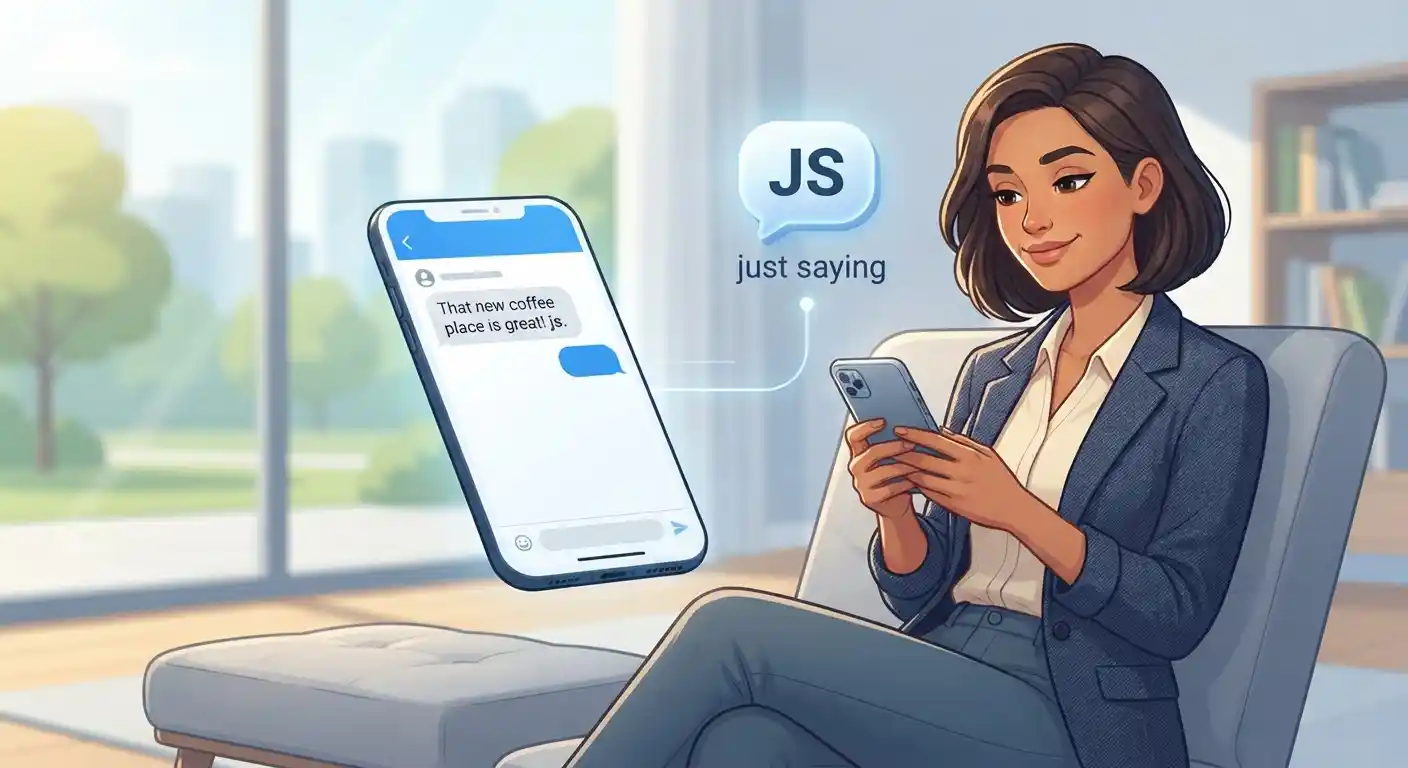
In text messages, JS usually means “just saying.” It is a casual texting abbreviation used to add an opinion, observation, suggestion, or mild criticism without making the message sound overly serious or forceful.
Key Takeaways
- JS most commonly means “just saying” in casual texting and online conversations.
- It often appears at the end of a statement to make an opinion or comment feel less direct.
- In some messages, lowercase “js” can also be shorthand for “just,” especially when it appears before another word.
- In technology and programming discussions, JS usually means JavaScript, not “just saying.”
- The tone can be casual, playful, blunt, teasing, or slightly defensive depending on the message around it.
- JS is informal texting slang and is generally better suited to casual communication than formal or professional writing.
JS Meaning in Text
The main JS meaning in text is “just saying.” It is an informal texting abbreviation that people use when sharing a thought, opinion, observation, suggestion, or criticism.
For example:
“That restaurant is overrated, js.”
Here, js means “just saying.” The sender is giving their opinion without necessarily trying to argue with the other person.
JS often works as a conversational softener. It can make a statement feel less demanding or absolute, although it does not automatically make a comment polite. Depending on the wording, it can also sound sarcastic, teasing, blunt, or defensive.
You may see JS in text messages, DMs, group chats, social media comments, and other casual online conversations.
There is another important use to watch for: “js” can sometimes be a shortened form of “just.” For example, in a message such as “js wondering” or “js kidding,” the intended meaning may simply be “just wondering” or “just kidding.” The surrounding sentence usually makes this clear.
What Does JS Stand For?
When JS is used as texting slang to mean “just saying,” the letters come from the first letters of Just Saying.
It is best understood as an informal texting abbreviation or internet slang expression rather than a formal acronym.
The exact placement can help identify the meaning:
- “That was a weird ending, js.” → just saying
- “You should probably check again, js.” → just saying
- “I’m js asking.” → likely just asking
So, JS does not have one meaning in every message. Context matters.
How Is JS Used?
In Text Messages

JS can be added after an opinion, suggestion, or observation.
“You should leave earlier tomorrow, js.”
The sender is offering advice without presenting it as a command.
In DMs
Someone may use JS when making a personal observation.
“You looked really good in that picture, js.”
Here, it can simply mean “just saying” and does not automatically indicate romantic interest.
In Group Chats
JS can introduce a personal opinion without turning the message into a formal argument.
“I think the first movie was better, js.”
On Social Media
JS may appear in comments or captions when someone wants to add a quick opinion or reaction.
“That outfit is actually better than the original, js.”
In Casual Online Conversations
People can also use JS after mild criticism, advice, or a reminder.
“Maybe read the instructions next time, js.”
In this situation, the abbreviation does not necessarily make the comment friendly. The wording still determines much of the tone.
JS in Different Contexts
The meaning of JS can change significantly depending on the surrounding conversation.
From a Friend
If a friend says:
“You spend way too much on coffee, js.”
They are probably using JS to mean “just saying.” It frames the comment as a personal observation or opinion.
From a Crush
If someone says:
“You looked really cute today, js.”
JS does not prove that they are flirting. The message may be playful or complimentary, but the relationship and the rest of the conversation provide the real context.
In Dating
A message such as:
“You could text me first sometimes, js.”
could express mild frustration or a suggestion. JS does not automatically make it romantic or hostile.
In a Relationship
Someone might write:
“I think we should talk about that, js.”
Here, JS may soften the statement while still signaling that the topic matters.
In a Group Chat
If someone says:
“That was definitely the best song on the album, js.”
JS simply marks the statement as their opinion.
In Social Media Comments
JS can be used as a casual tag after an observation:
“The old version was better, js.”
The meaning is usually clear from the sentence itself.
Why Context Matters
When interpreting JS, look at:
- The words before and after it
- Whether it appears at the end of a sentence
- The topic of the conversation
- Punctuation
- Emojis
- The relationship between the people
- Whether the conversation is casual or technical
JS by itself does not establish whether someone is flirting, criticizing, joking, or being serious.
Real Chat Examples
Example 1
Alex: I think that movie was overrated, js.
Meaning: Alex is casually sharing an opinion.
Example 2
Mia: You should probably bring a jacket tomorrow, js.
Meaning: Mia is offering a suggestion.
Example 3
Sam: That restaurant is way too expensive, js.
Meaning: Sam is giving a personal opinion.
Example 4
Jordan: You could have told me earlier, js.
Meaning: Jordan is expressing mild frustration.
Example 5
Taylor: I actually liked the ending, js.
Meaning: Taylor is adding their personal view.
Example 6
Chris: You look better with shorter hair, js.
Meaning: Chris is making a personal observation.
Example 7
Jamie: Maybe check the address again, js.
Meaning: Jamie is giving a casual reminder.
Example 8
Riley: That was definitely your best photo, js.
Meaning: Riley is giving a compliment or opinion.
Example 9
Morgan: I think we should leave now, js.
Meaning: Morgan is suggesting that they leave.
Example 10
Casey: You really should watch that show, js.
Meaning: Casey is casually recommending something.
Example 11
Drew: The first game was more fun, js.
Meaning: Drew is sharing an opinion.
Example 12
Avery: You might want to save that file somewhere else, js.
Meaning: Avery is giving advice.
Example 13
Jordan: That outfit actually looks great on you, js.
Meaning: Jordan is making a casual compliment.
Example 14
Sam: I wouldn’t order that again, js.
Meaning: Sam is expressing a negative opinion.
Example 15
Mia: I think you deserve better, js.
Meaning: Mia is offering a personal opinion, potentially with emotional context.
Example 16
Chris: js wondering if you’re still coming.
Meaning: Here, “js” most likely means “just,” not “just saying.”
Example 17
Taylor: I’m js kidding 😂
Meaning: Here, “js” means “just.”
Example 18
Alex: js wanted to ask you something.
Meaning: Here, JS is functioning as a shortened form of “just.”
How to Reply to JS
Your reply should depend on what the person actually said. JS does not require one specific response.
Casual Replies
- “Yeah, I get what you mean.”
- “Fair enough.”
- “I was thinking the same thing.”
- “Honestly, you might be right.”
Friendly Replies
- “Haha, I know what you mean.”
- “Good point.”
- “I appreciate the honesty.”
- “That’s actually helpful.”
Funny Replies
- “You said it, not me 😂”
- “And now you’ve officially said it.”
- “JS has been noted 😂”
- “Okay, okay, message received.”
Neutral Replies
- “Got it.”
- “I see what you mean.”
- “Thanks for letting me know.”
- “That makes sense.”
Flirty or Relationship Replies
Only use a flirty response when the rest of the conversation already has that tone.
- “Just saying… or trying to tell me something? 👀”
- “I’ll take that as a compliment.”
- “Interesting observation 😏”
- “And what exactly are you saying?”
Do not assume JS itself means flirting. The surrounding conversation matters more than the abbreviation.
What Tone Does JS Have?
JS is generally casual and informal, but its exact tone depends on the statement surrounding it.
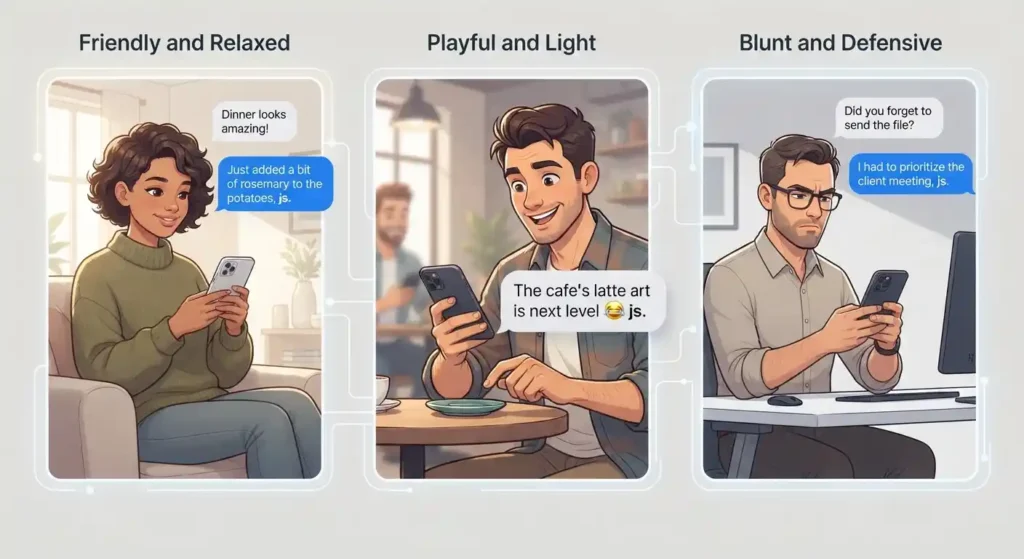
It can sound:
- Casual: “That place is pretty good, js.”
- Friendly: “You should try this one, js.”
- Playful: “You know I’m right, js 😂.”
- Blunt: “You could have planned better, js.”
- Teasing: “You really thought that was a good idea, js.”
- Defensive: “I wasn’t trying to be rude, js.”
Because JS can soften a statement without removing its meaning, it may sometimes come across as passive-aggressive or dismissive. That usually comes from the complete message rather than the abbreviation itself.
Is JS Rude or Offensive?
JS is not inherently rude or offensive. It is generally harmless informal slang.
It is fine in casual conversations with friends, family, and other people who are comfortable with texting shorthand.
However, the sentence containing JS can still be rude.
For example:
“You should really learn how to do your job, js.”
The JS does not make that criticism automatically polite.
For school, work, customer communication, applications, or other formal situations, spelling out the thought is usually clearer and more appropriate than relying on texting shorthand.
Other Meanings of JS
JS in Technology
In technology and programming, JS commonly means JavaScript, a programming language used extensively for web development and other software applications.
For example:
“I wrote the feature in JS.”
Here, JS clearly means JavaScript, not “just saying.”
The topic provides the clue. If the conversation is about code, websites, programming, frameworks, or development, JavaScript is the likely interpretation.
JS as a Short Form of “Just”
In casual messages, lowercase js can sometimes shorten the word “just.”
Examples include:
- “js wondering”
- “js asking”
- “js kidding”
- “js wanted to know”
In these examples, expanding JS to “just saying” would not make sense.
JS as Personal Initials
JS can also represent someone’s initials.
For example:
“JS sent me the files.”
If people in the conversation know someone whose initials are J.S., the letters may simply refer to that person.
Common Mistakes About JS
Assuming JS Always Means “Just Saying”
Not every lowercase “js” means “just saying.” If it appears before another word, it may simply be shorthand for “just.”
Assuming JS Always Means JavaScript
JavaScript is a major meaning of JS in technology, but it is usually not what someone means when they add “js” to the end of a casual text.
Assuming JS Means Someone Is Flirting
JS does not automatically indicate attraction or romantic interest. A message may be flirtatious because of its overall wording, but the abbreviation itself does not prove it.
Treating JS as Formal Language
JS is casual shorthand. It works naturally in informal digital conversations but is usually unnecessary in formal writing.
Ignoring the Conversation
The safest way to interpret JS is to read the complete message and consider the topic. “JS” in a programming discussion and “js” at the end of a friend’s opinion can mean completely different things.
JS and Related Slang
| Term | Meaning | Common Use |
|---|---|---|
| JS | Just saying / sometimes just | Casual texting |
| TBH | To be honest | Giving an honest opinion |
| IMO | In my opinion | Sharing a personal view |
| IMHO | In my humble opinion | Giving a personal opinion |
| FYI | For your information | Sharing information or a reminder |
| NGL | Not gonna lie | Introducing an honest reaction |
These terms overlap in purpose, but they are not interchangeable. JS often works as a short tag after a statement, while terms such as TBH, IMO, and NGL more directly introduce an opinion or reaction.
People Also Ask About JS
Does JS mean “just saying” in text?
Yes. In casual texting, JS commonly means “just saying.” It is often added to an opinion, observation, suggestion, or criticism to present it as a casual comment.
Can JS mean “just” in texting?
Yes. Lowercase js can sometimes be used as a shortened form of “just,” especially before another word, such as “js wondering” or “js kidding.” The sentence usually makes this meaning clear.
Does JS mean JavaScript?
In technology and programming conversations, JS usually means JavaScript. If someone is talking about coding, websites, software, or development, this is likely the intended meaning.
Is JS flirting?
Not by itself. JS does not inherently mean flirting or romantic interest. A person may use it in a flirty message, but the wording, relationship, and conversation provide the relevant context.
Is JS rude?
JS itself is not rude or offensive. However, it can appear in a blunt, sarcastic, or critical message, so the overall wording determines how the message comes across.
What does lowercase js mean?
Lowercase js commonly means “just saying” when it appears as a standalone tag or at the end of a sentence. In some messages, it can instead mean “just,” so its position in the sentence matters.
How should I reply when someone says JS?
There is no special reply required. You can respond naturally to the statement itself, such as “Fair enough,” “I see what you mean,” or “Haha, I get it.” If the message seems flirtatious, your response can match that tone.
Conclusion
In casual texting, JS most commonly means “just saying.” It is informal shorthand used to share an opinion, observation, suggestion, or comment without presenting it as a formal statement.
The abbreviation can also mean “just” in some messages, while JS means JavaScript in technology and programming contexts. Because of these different uses, the surrounding sentence and conversation are important.
JS is generally casual rather than rude or offensive, but its tone can range from friendly and playful to blunt or defensive. When in doubt, read the complete message before deciding what the sender meant.

Michael Anderson writes pun and joke articles built around clever wordplay, covering food, animals, seasons, technology, entertainment, and trending topics. Across 3.5 years of experience, he has refined punchlines by comparing wording, shaping joke collections, and polishing phrasing for clarity and flow. His work focuses on keeping each pun fresh, well-structured, and suited to its theme.