Social media slang refers to informal words, phrases, abbreviations, acronyms, and expressions used in online conversations, posts, comments, DMs, and chats. It includes terms such as LOL, POV, FYP, DM, no cap, ate, rizz, and IRL.
Key Takeaways
- Social media slang is a broad category, not one specific acronym or phrase.
- It includes texting abbreviations, internet expressions, memes, platform-specific terms, and shortened phrases.
- The meaning of slang can change depending on the conversation, platform, community, and tone.
- Some terms are used mainly in private chats, while others appear in comments, captions, videos, or hashtags.
- Social media slang is generally informal and is not always suitable for professional or formal writing.
- Context matters, especially when a slang term could sound playful, sarcastic, critical, or romantic.
Social Media Slang Meaning in Text
Social media slang is the informal language people use to communicate online. It can include text slang, internet slang, messaging shorthand, abbreviations, acronyms, memes, emojis, and expressions that develop within online communities.
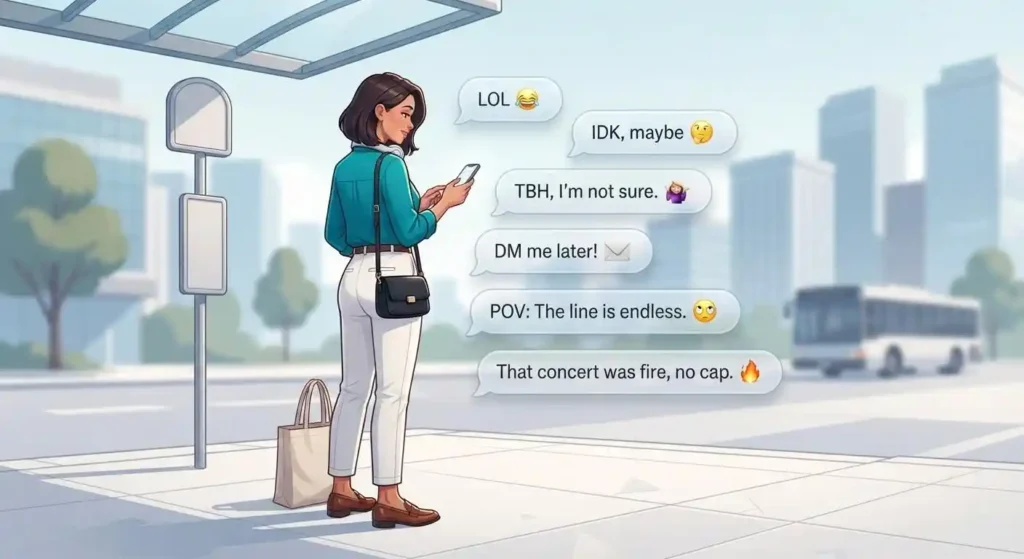
Unlike a traditional dictionary term, social media slang does not have one fixed vocabulary. Some expressions are shortened versions of ordinary phrases, such as IDK for “I don’t know” or TBH for “to be honest.” Others are standalone slang expressions, such as no cap, ate, rizz, or touch grass.
The meaning also depends on context. For example, “ate” can be praise when someone performed extremely well, while “sus” can describe something that seems suspicious. A term that sounds playful between friends could sound inappropriate or confusing in a professional conversation.
Social media slang appears across different types of online communication, including:
- Text messages
- Direct messages
- Group chats
- Instagram comments
- TikTok comments and captions
- YouTube comments
- X posts and replies
- Snapchat conversations
- Reddit discussions
- Gaming chats
The safest way to interpret unfamiliar slang is to look at the whole message, rather than assuming the abbreviation or phrase always has one meaning.
What Does Social Media Slang Stand For?
Social media slang does not stand for a specific phrase. It is a general term describing informal language used on social networking platforms and other forms of online communication.
The word slang refers to informal vocabulary associated with particular groups, situations, or communities. Therefore, “social media slang” describes slang that is commonly encountered in digital communication.
Some individual examples within social media slang do have full forms:
- LOL = Laugh Out Loud
- IDK = I Don’t Know
- TBH = To Be Honest
- IRL = In Real Life
- POV = Point of View
- FYP = For You Page
- DM = Direct Message
- ICYMI = In Case You Missed It
So, social media slang itself is not an acronym.
How Is Social Media Slang Used?
Social media slang is mainly used to make online communication shorter, more expressive, humorous, or conversational.
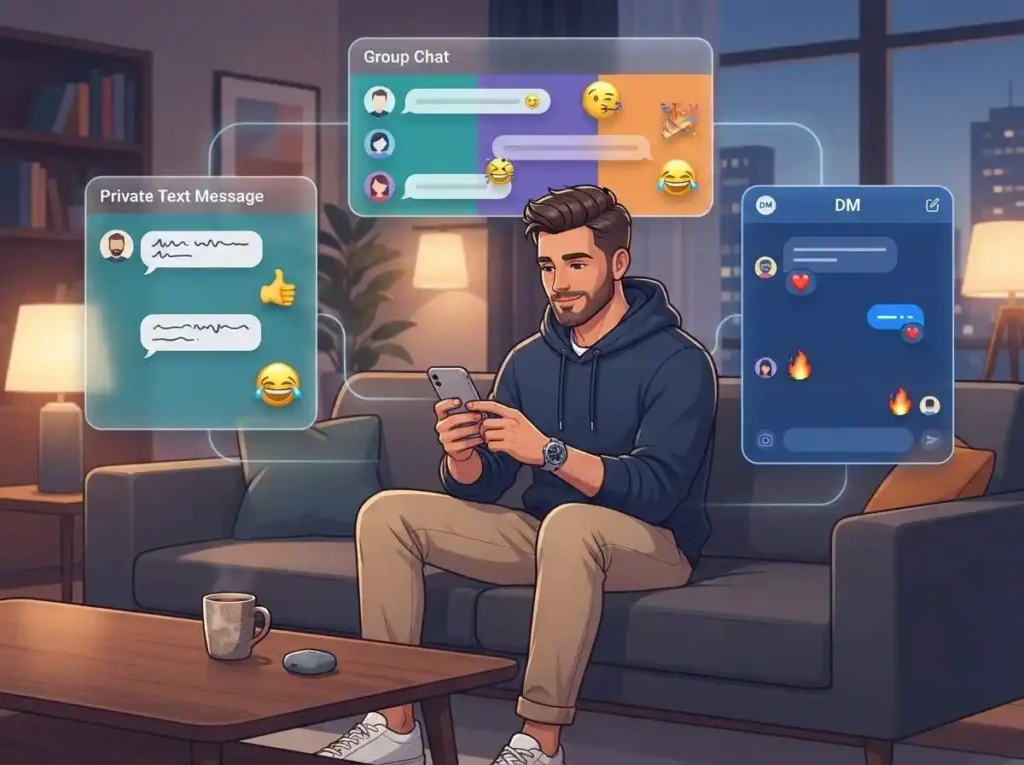
Text Messages
People use abbreviations to communicate quickly.
“IDK if I can make it tonight.”
“TBH, I liked the first movie better.”
DMs
Direct messages often use casual expressions because they resemble ordinary conversations between friends.
“LOL you actually did it.”
“BTW, are you coming tomorrow?”
Group Chats
Group chats commonly combine abbreviations, reactions, memes, and slang.
“That was wild 😭”
“No cap, that was the funniest thing today.”
Social Media Comments
Slang can express approval, disbelief, humor, or criticism in just a few words.
“She ate.”
“This is so real.”
“Bro is cooked.”
Captions and Posts
Creators may use slang to make captions sound conversational or connected to online culture.
“POV: You finally survived Monday.”
“GRWM for dinner.”
Gaming
Some social media slang overlaps with gaming language, especially in chats and communities.
Terms such as GG, AFK, OP, and W can appear in gaming-related conversations.
Social Media Slang in Different Contexts
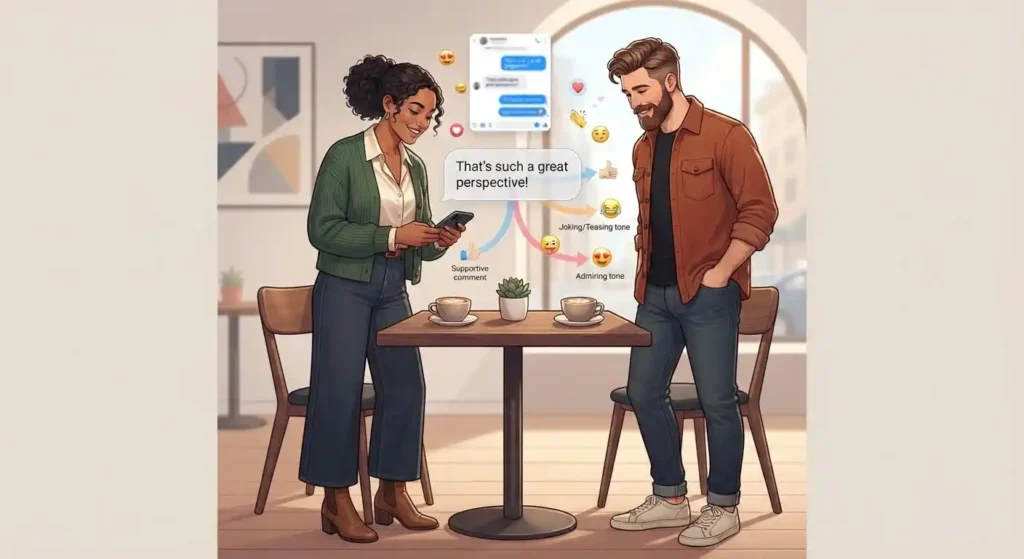
The same slang expression can carry different shades of meaning depending on who uses it and why.
From a Friend
A friend may use slang casually without intending any deeper message.
“You ate that outfit.”
This usually communicates praise.
From a Guy
The slang itself does not automatically indicate romantic interest.
If someone says:
“You ate 🔥”
it could simply be a compliment. The surrounding conversation, emojis, relationship, and previous messages provide more information.
From a Girl
The same principle applies. A slang phrase does not automatically become romantic because of the sender’s gender.
From a Crush
Context matters more if there is already romantic conversation.
For example:
“You look good today 👀”
could potentially be flirtatious, but the phrase alone does not prove attraction.
In Dating
Some slang has relationship-specific meanings, such as breadcrumbing, ghosting, or benching. These terms describe particular dating behaviors rather than ordinary texting shorthand.
In a Relationship
Partners may use slang playfully, affectionately, sarcastically, or casually. The meaning depends heavily on their established communication style.
In a Group Chat
Slang can become an inside joke or community-specific shorthand. A phrase that makes perfect sense to one group may confuse someone outside it.
In Social Media Comments
Comments can be more exaggerated because users often react quickly.
“BRO ATE 😭”
This may simply mean the person did something extremely well.
Real Chat Examples
Here are realistic examples showing how different types of social media slang appear naturally:
- “LOL I completely forgot about that.”
Meaning: Laughing out loud. - “IDK what we’re doing tonight.”
Meaning: I don’t know. - “TBH, that restaurant was better last time.”
Meaning: To be honest. - “Can you DM me the address?”
Meaning: Send me a direct message. - “POV: You said you’d only watch one episode.”
Meaning: Point of view; introducing a scenario. - “I’m tired RN.”
Meaning: Right now. - “ICYMI, the tickets are finally available.”
Meaning: In case you missed it. - “No cap, this is the best burger I’ve had.”
Meaning: Honestly; no lie. - “She absolutely ate that performance.”
Meaning: She performed extremely well. - “That excuse sounds sus.”
Meaning: That excuse sounds suspicious. - “That song is a banger.”
Meaning: The song is very good or exciting. - “Bro has serious rizz.”
Meaning: Bro has strong flirting or charm skills. - “W friend for helping me move.”
Meaning: A “win” or praise for the friend. - “This comment section is wild.”
Meaning: The comments are unusually funny, chaotic, surprising, or intense. - “IYKYK.”
Meaning: If you know, you know; usually referring to an inside reference or shared experience. - “Please touch grass.”
Meaning: Stop spending so much time online and reconnect with ordinary offline life. - “That outfit is giving.”
Meaning: The outfit has a particular appealing or impressive vibe. - “GRWM because I’m already late.”
Meaning: Get ready with me. - “That take is wild 💀.”
Meaning: The person’s opinion is surprising, absurd, or difficult to believe. - “You understood the assignment.”
Meaning: You did exactly what was expected, especially in an impressive way.
How to Reply to Social Media Slang
Because social media slang covers many different expressions, the best reply depends on the specific term and conversation.
Casual Replies
- “LOL, exactly.”
- “Yeah, I get you.”
- “For real.”
- “Same honestly.”
- “I know 😂”
Friendly Replies
- “Haha, I was thinking the same thing.”
- “You’re not wrong.”
- “That actually made me laugh.”
- “Okay, you got me.”
- “Fair point.”
Funny Replies
- “Bro, what does that even mean? 😂”
- “I had to Google that one.”
- “Okay, internet translator, please.”
- “You’re speaking fluent internet.”
- “I’m officially lost 😭”
Neutral Replies
- “What do you mean by that?”
- “Can you explain?”
- “I’m not familiar with that term.”
- “What does that mean here?”
- “Got it.”
Flirty/Relationship Replies
These work only when the surrounding conversation is already playful or romantic:
- “Is that your way of complimenting me? 👀”
- “I’ll take that as a compliment.”
- “Careful, I might start believing you.”
- “Okay, smooth.”
- “Are you flirting with me right now?”
The slang itself should not be treated as proof of romantic interest.
What Tone Does Social Media Slang Have?
Social media slang is generally casual and informal, but individual expressions can communicate different tones.
Casual
“IDK, maybe later.”
Friendly
“W friend.”
Playful
“Bro really thought nobody would notice 😂”
Humorous
“I’m cooked.”
Sarcastic
“Yeah, because that worked so well last time.”
Direct
“No cap.”
Informal
“DM me when you get there.”
Context-Dependent
Some expressions can be positive, negative, sarcastic, or humorous depending on the surrounding conversation.
That is why punctuation, emojis, previous messages, and the relationship between the people involved can matter when interpreting online slang.
Is Social Media Slang Rude or Offensive?
Social media slang is not automatically rude or offensive. Most common slang is simply informal language.
It is generally more natural in:
- Casual conversations
- Friend group chats
- Social media comments
- DMs
- Informal online communities
It may be less appropriate in:
- Formal school assignments
- Job applications
- Professional emails
- Business documents
- Formal presentations
The important distinction is informal versus professional, rather than assuming slang is inherently inappropriate.
Some individual slang terms can contain profanity, sexual references, insults, or culturally sensitive language. Those terms should be judged separately rather than treating all social media slang as the same.
Other Meanings of Social Media Slang
“Social media slang” does not have a major alternative expansion or technical definition. However, the individual terms inside the category can have different meanings in other fields.
Social Media in Technology
In technology discussions, abbreviations such as DM, API, URL, UX, and UI may appear alongside social media terminology. These are not necessarily slang; some are standard technical abbreviations.
Social Media in Gaming
Gaming communities use terms such as GG, AFK, OP, NPC, W, and L. Some originated in gaming and later became common in broader online conversations.
Social Media in Business
Business and marketing conversations may use terms such as UGC for user-generated content, CTA for call to action, and KPI for key performance indicator.
These are better classified as professional or industry terminology rather than ordinary slang.
Common Mistakes About Social Media Slang
Assuming Every Abbreviation Is Slang
Not every shortened term is slang. Some are standard abbreviations used in technology, business, education, or other fields.
Assuming One Meaning Always Applies
A term can have different meanings in different communities or contexts. Always consider the surrounding message.
Assuming Slang Proves Romantic Interest
A compliment, emoji, or slang expression does not automatically mean someone is flirting.
Treating All Online Slang as Current
Internet language changes. Some expressions remain widely recognizable while others are tied to particular trends or communities.
Using Slang in Formal Communication
A phrase that sounds natural in a group chat may look unprofessional in a business email or formal assignment.
Assuming Platform Context Does Not Matter
Some expressions are strongly associated with particular types of content or online communities. Context can help clarify the intended meaning.
Social Media Slang and Related Slang
| Term | Meaning | Common Use |
|---|---|---|
| LOL | Laugh out loud | Humor and reactions |
| IDK | I don’t know | Uncertainty |
| TBH | To be honest | Opinions and honesty |
| POV | Point of view | Scenario-based posts |
| FYP | For You Page | Short-form video content |
| DM | Direct message | Private communication |
| IRL | In real life | Offline experiences |
| ICYMI | In case you missed it | Sharing or highlighting content |
| No cap | No lie; honestly | Emphasizing truth |
| Ate | Did something extremely well | Praise |
| Rizz | Charm or flirting ability | Dating and social interactions |
| Sus | Suspicious | Doubt or suspicion |
| GOAT | Greatest of all time | High praise |
| IYKYK | If you know, you know | Shared references |
| GRWM | Get ready with me | Lifestyle and preparation content |
People Also Ask About Social Media Slang
What is social media slang?
Social media slang is informal language used in online communication. It includes abbreviations, acronyms, shortened phrases, memes, expressions, and platform-specific vocabulary.
Is social media slang the same as internet slang?
The terms overlap heavily. Internet slang is broader and can include language from forums, gaming communities, messaging apps, and other online spaces, while social media slang specifically emphasizes language encountered on social networking platforms.
Why do people use slang on social media?
People use slang to communicate casually, express emotion, shorten messages, participate in online culture, and respond quickly. Some expressions also help people communicate shared humor or references.
Is social media slang appropriate for work?
It depends on the workplace and the specific expression. Casual slang may be acceptable in an informal team chat, but professional emails, reports, applications, and formal documents generally call for clearer standard language.
Can social media slang have more than one meaning?
Yes. Context can change the interpretation of an abbreviation, word, or phrase. The platform, conversation topic, community, punctuation, emojis, and previous messages can all provide useful clues.
What is the difference between slang and an abbreviation?
An abbreviation shortens a word or phrase, such as DM for direct message. Slang is informal vocabulary or expressions associated with particular social or cultural contexts. Some abbreviations are slang, but not all abbreviations are slang.
Is social media slang only used by young people?
No. Online slang is used by people across different age groups and communities. Individual expressions may be associated with particular communities or trends, but slang itself is not limited to one age group.
How can I understand an unfamiliar slang term?
Read the entire message and consider the conversation, platform, emoji use, and relationship between the people involved. If the meaning is still unclear, asking the sender directly is usually more reliable than guessing.
Conclusion
Social media slang is a broad category of informal online language rather than a single acronym or phrase. It includes texting abbreviations, internet expressions, memes, social-media terminology, and community-specific vocabulary.
There is no fixed full form for “social media slang,” and its meaning depends on the individual term being used. Most slang is casual and works best in texts, DMs, group chats, comments, and informal conversations.
Context remains the key to understanding it. A slang expression can be funny, friendly, sarcastic, complimentary, or neutral depending on the conversation, while formal communication usually calls for standard language.

As a writer, Andrew Mitchell focuses on puns and jokes shaped by the vocabulary and quirks of each subject. His four years of experience include working across food, animals, seasonal themes, technology, entertainment, and trending topics. Andrew maps relevant terms, experiments with meanings and phrasing, and edits each joke to sharpen its setup, wordplay, and punchline.