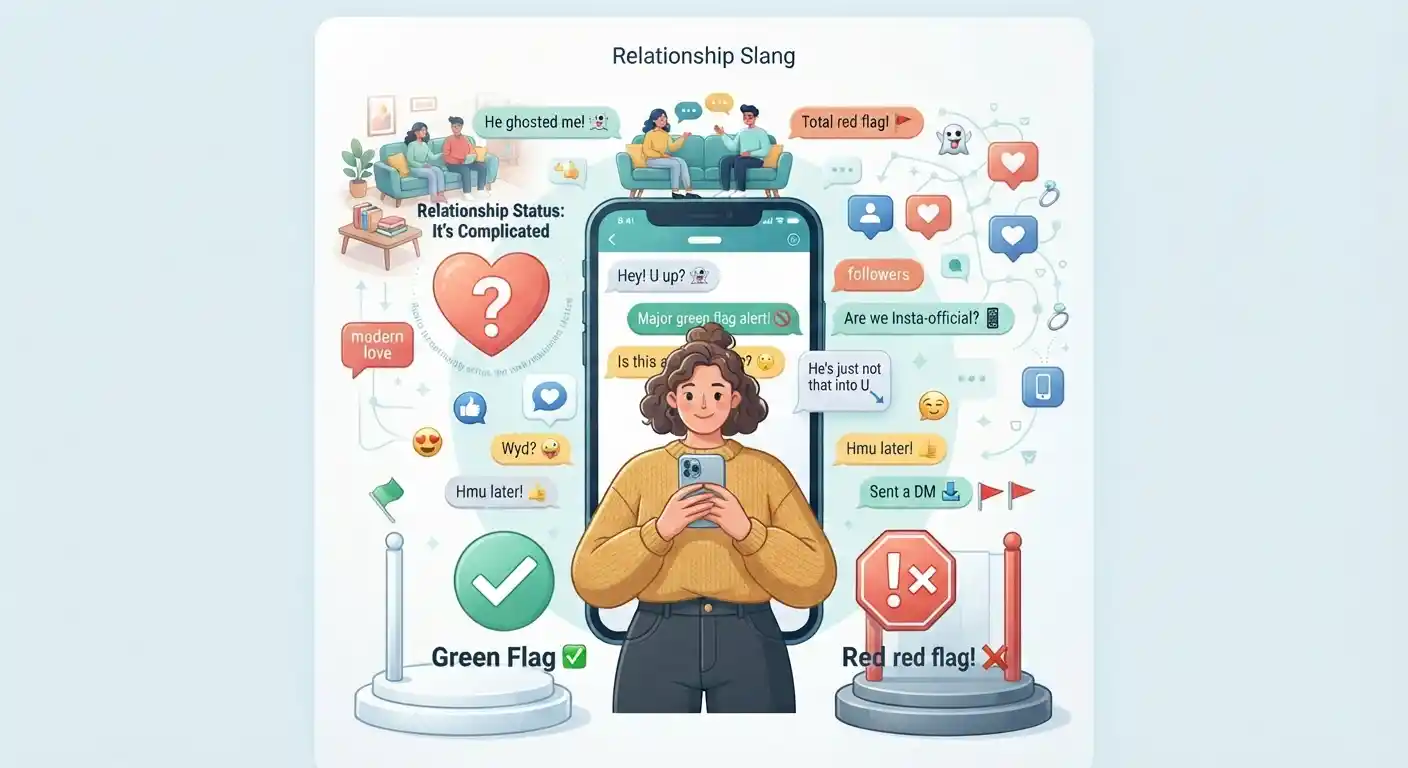
Relationship slang refers to informal words, phrases, and abbreviations people use to describe dating, attraction, romantic relationships, relationship stages, and dating behavior. Common examples include situationship, talking stage, ghosting, DTR, FWB, soft launch, red flag, green flag, and breadcrumbing.
Key Takeaways
- Relationship slang is informal language used to describe modern dating, romance, and relationship situations.
- It can describe relationship stages, behaviors, feelings, boundaries, or social-media activity.
- Terms such as talking stage and situationship describe relationships that have not reached a clearly defined status.
- Some relationship slang is made specifically for texting and social media, while other terms are also common in spoken conversation.
- Context matters because the same abbreviation can have different meanings outside dating conversations.
- Relationship slang usually works best in casual communication rather than professional or formal writing.
Relationship Slang Meaning in Text
In texting and online communication, relationship slang means informal vocabulary used to talk about romantic connections, dating behavior, attraction, commitment, and relationship status.
Unlike one specific texting abbreviation, “relationship slang” is a broad category. It includes ordinary slang words, phrases, abbreviations, and internet expressions.
For example:
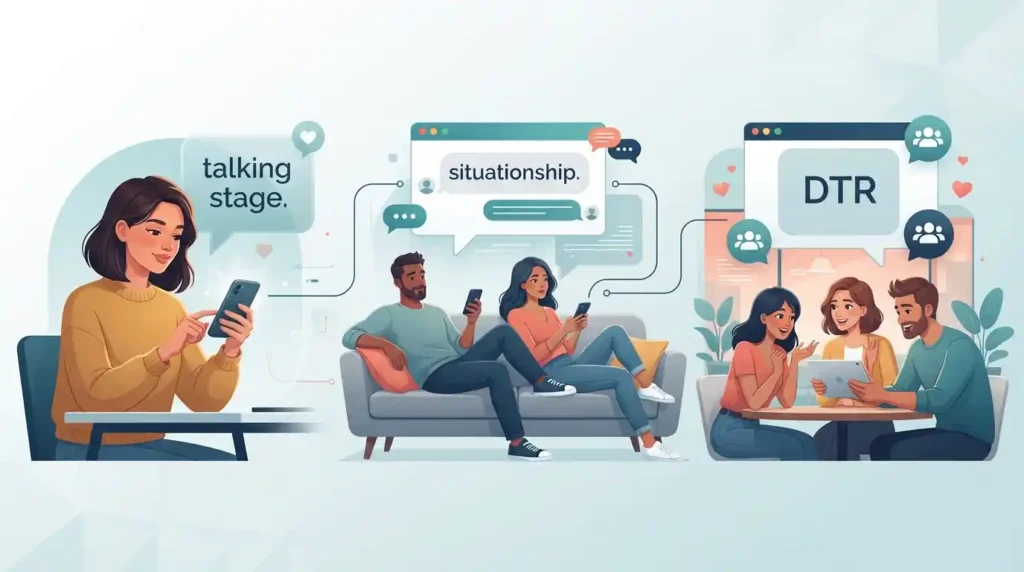
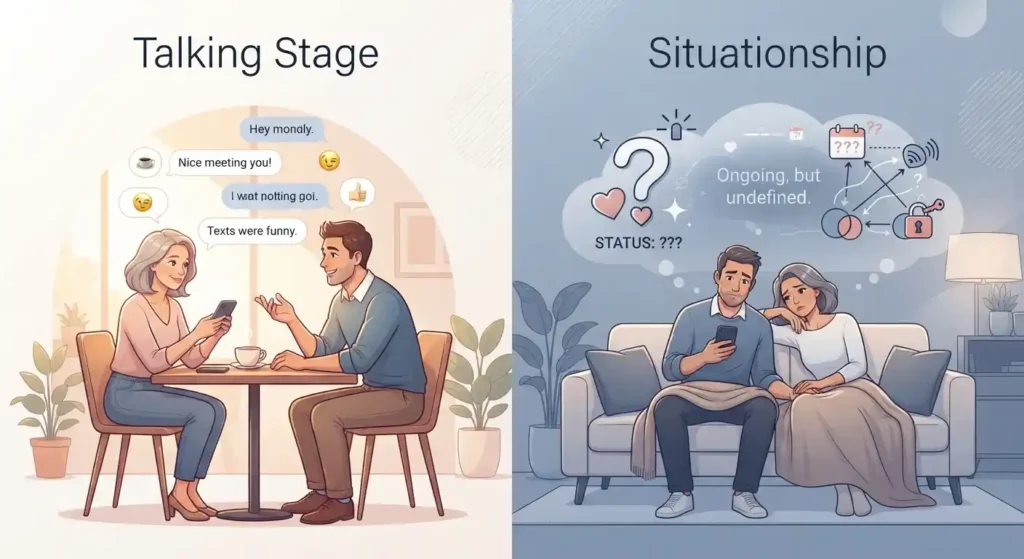
- Talking stage = an early period of romantic interest before a relationship is officially defined.
- Situationship = a romantic connection that remains undefined or lacks clear commitment.
- DTR = “define the relationship,” usually referring to a conversation about what two people are.
- Ghosting = suddenly stopping communication without explanation.
- Soft launch = subtly revealing a relationship on social media.
- Hard launch = openly announcing or showing a relationship online.
- FWB = “friends with benefits,” referring to friends who also have a sexual relationship without a traditional romantic commitment.
- Breadcrumbing = giving someone occasional attention that keeps them interested without meaningful follow-through.
The tone can range from playful and humorous to serious, critical, or descriptive. A person’s choice of slang does not automatically prove how they feel about another person.
What Does Relationship Slang Stand For?
Relationship slang does not have one fixed full form. It is a category name rather than a traditional acronym.
Some individual relationship slang terms are abbreviations or acronyms, however. For example:
- DTR = Define the Relationship
- FWB = Friends With Benefits
- NSA = No Strings Attached
- ONS = One-Night Stand
Other terms are regular words or combinations of words rather than abbreviations. Situationship, for example, combines “situation” and “relationship” to describe an undefined romantic connection.
So, if someone asks what “relationship slang” stands for, the simplest answer is that it doesn’t have a single expansion. It describes a whole group of informal dating and relationship expressions.
How Is Relationship Slang Used?
Relationship slang appears in many forms of casual communication.
Text Messages
People may use it when discussing their own dating life or asking friends for advice.
“Are you guys official yet, or are you still in the talking stage?”
“I think we’re in a situationship.”
DMs
Dating slang is common in private social-media conversations, especially when people discuss attraction, dating intentions, or relationship status.
“So are you two actually dating?”
“He soft-launched his girlfriend last night.”
Group Chats
Friends often use relationship terms when discussing dates, crushes, breakups, or confusing romantic situations.
“Girl, that’s not a relationship. That’s a situationship.”
Social Media
Terms such as soft launch, hard launch, red flag, green flag, and the ick can appear in captions, comments, memes, and relationship discussions.
Dating Conversations
Some expressions are used directly when discussing relationship expectations.
“We probably need to DTR.”
“Are we exclusive?”
Relationship slang can therefore describe both what a relationship is and what happens inside or around it.
Relationship Slang in Different Contexts
The meaning of relationship slang is often easier to understand when you consider the surrounding conversation.
From a Friend
A friend might use relationship slang casually:
“You’re definitely in the talking stage.”
The phrase usually describes a dating situation rather than making a serious judgment.
From a Guy
If a guy says, “We’re just talking,” he may simply be describing an early stage of dating. The phrase itself does not prove whether he wants a serious relationship.
From a Girl
The same applies when a girl uses terms such as “situationship,” “talking stage,” or “exclusive.” Gender does not automatically change the meaning of the slang.
From a Crush
Relationship slang can become more emotionally loaded when a crush uses it.
For example:
“Are we exclusive?”
That question may indicate that the person wants clarity, but the exact intention depends on the conversation and relationship.
In Dating
Dating conversations commonly use terms for relationship stages, expectations, attraction, and commitment.
In a Relationship
Once two people are officially together, slang may shift toward terms describing relationship behavior, social-media announcements, boundaries, or problems.
In a Group Chat
Friends may use relationship slang humorously:
“He ghosted you? Delete the number.”
The phrase can be playful even when the underlying situation is serious.
In Social Media Comments
Relationship slang can also be used as a reaction:
“Major green flag.”
“That’s giving situationship.”
“Ick.”
The surrounding post usually determines what the commenter means.
Important: slang alone cannot prove that someone is flirting, falling in love, rejecting someone, or cheating. Look at the complete conversation, previous messages, wording, punctuation, emojis, and relationship between the people involved.
Real Chat Examples
Here are realistic examples showing how relationship slang can appear in everyday conversations:
- “Are you guys dating or still in the talking stage?”
→ Asking whether the relationship has become official. - “We’ve been seeing each other for months, but we’re not official.”
→ Describing an undefined dating situation. - “I think I’m in a situationship.”
→ Saying the romantic connection lacks a clear label. - “We need to DTR soon.”
→ Saying that the relationship status needs to be discussed. - “He ghosted me after three dates.”
→ Saying that the person suddenly stopped communicating. - “She soft-launched her boyfriend on Instagram.”
→ Saying she subtly revealed that she has a partner. - “Okay, that’s a hard launch.”
→ Reacting to a clear public relationship announcement. - “He’s definitely a green flag.”
→ Saying his behavior appears positive or trustworthy. - “That was such a red flag.”
→ Calling a behavior a warning sign. - “I got the ick after that date.”
→ Saying a particular behavior suddenly reduced romantic attraction. - “Are you two exclusive?”
→ Asking whether they have agreed to date only each other. - “We’re keeping things casual for now.”
→ Saying the relationship is not currently being treated as serious. - “He’s breadcrumbing you.”
→ Describing inconsistent attention without meaningful follow-through. - “She keeps liking my stories but never messages me.”
→ Describing low-level social-media attention that may or may not indicate interest. - “Do you have rizz, or are you just lucky?”
→ Playfully asking about someone’s ability to attract or charm people. - “We’re just FWB.”
→ Describing a friends-with-benefits arrangement. - “I think we should talk about what we are.”
→ Moving toward a relationship-definition conversation. - “He finally hard-launched his girlfriend.”
→ Saying he publicly identified or showed his partner online. - “I’m tired of being stuck in the talking stage.”
→ Saying the early dating phase has continued without progressing. - “That’s giving red flag energy.”
→ Informally describing someone’s behavior as concerning.
How to Reply to Relationship Slang
Because relationship slang is a broad category, the best reply depends on the specific term and situation.
Casual Replies
- “Ohhh, I get what you mean.”
- “That makes sense.”
- “So you’re still in the talking stage?”
- “Got it.”
Friendly Replies
- “Okay, now I understand the situation.”
- “Honestly, I’d ask them what they want.”
- “That sounds complicated.”
- “You two should probably talk about it.”
Funny Replies
- “So basically, you’re professionally unofficial.”
- “Ah yes, the classic ‘what are we?’ era.”
- “Sounds like a situationship with extra steps.”
- “Dating really needs a user manual.”
Neutral Replies
- “What do you mean by that?”
- “Are you two officially together?”
- “Do you both want the same thing?”
- “I wouldn’t assume anything without asking.”
Flirty/Relationship Replies
When the conversation is clearly romantic, you could say:
- “So what are we, then? 👀”
- “Maybe it’s time we DTR.”
- “I wouldn’t mind making this official.”
- “I think we should talk about where this is going.”
The safest response to an unclear relationship term is often a simple clarification question rather than an assumption.
What Tone Does Relationship Slang Have?
Relationship slang is usually casual and informal, but individual terms can carry very different emotional tones.
- Casual: “We’re just talking.”
- Playful: “He has serious rizz.”
- Neutral: “Are you two exclusive?”
- Serious: “We need to DTR.”
- Critical: “That’s a red flag.”
- Negative: “She ghosted him.”
- Humorous: “We’re in a situationship.”
- Context-dependent: “It’s giving relationship.”
The tone comes from both the term and the situation. A word that is funny between close friends may sound harsh when used during an actual relationship conflict.
Is Relationship Slang Rude or Offensive?
Relationship slang is generally appropriate for casual conversations, texting, group chats, DMs, and social media.
However, it is not usually the best choice for professional emails, formal documents, business communication, or academic writing.
Some individual expressions can also be sensitive. Terms describing sexual relationships, manipulation, cheating, or breakups may feel judgmental depending on how they are used.
For example, saying:
“That’s a red flag.”
can sound like a casual opinion between friends, while saying the same thing directly to someone’s partner may come across as criticism.
When discussing someone’s personal relationship, context and tone matter more than the slang itself.
Other Meanings of Relationship Slang
“Relationship slang” itself does not have a major alternative technical meaning. It is primarily a descriptive phrase for informal language associated with romantic relationships and dating.
However, individual terms within this category can have meanings outside romance.
For example, rizz can describe charisma or charm more generally, while some abbreviations have completely different meanings in technology, gaming, business, or other communities.
That is why context is especially important when interpreting short abbreviations.
Common Mistakes About Relationship Slang
Assuming All Relationship Slang Is an Acronym
Not every term is an abbreviation. Situationship, ghosting, breadcrumbing, red flag, and soft launch are not traditional acronyms.
Assuming Slang Has One Universal Meaning
A term can change meaning depending on the conversation. This is especially important with short abbreviations.
Assuming Slang Proves Romantic Intent
If someone says “you’re a green flag,” that does not automatically mean they want a relationship. Likewise, using “situationship” does not necessarily mean someone dislikes commitment.
Confusing the Talking Stage With a Situationship
These terms overlap, but they are not identical. The talking stage generally describes an early period of getting to know someone romantically, while a situationship describes an ongoing connection that remains undefined.
Treating Social-Media Behavior as Proof
A soft launch, story like, comment, or other online behavior can suggest something, but it does not establish someone’s intentions by itself.
Relationship Slang and Related Slang
| Term | Meaning | Common Use |
|---|---|---|
| Talking stage | Early romantic stage before the relationship is clearly defined | Dating, texting |
| Situationship | Romantic connection without a clear relationship label | Dating, social media |
| DTR | Define the relationship | Relationship conversations |
| Ghosting | Suddenly ending communication without explanation | Dating, texting |
| Breadcrumbing | Giving occasional attention without meaningful follow-through | Dating discussions |
| Soft launch | Subtly revealing a relationship online | Social media |
| Hard launch | Publicly revealing a relationship online | Social media |
| FWB | Friends with benefits | Casual dating |
| Rizz | Charm or ability to attract someone | Flirting, social media |
| Red flag | A warning sign in someone’s behavior | Dating discussions |
| Green flag | A positive sign or trait | Dating discussions |
| The ick | A sudden feeling of romantic repulsion or loss of attraction | Dating conversations |
These terms cover different parts of modern relationship language rather than describing the exact same thing.
People Also Ask About Relationship Slang
What is the most common relationship slang?
There is no single term that represents all relationship slang. Frequently discussed expressions include talking stage, situationship, ghosting, soft launch, red flag, green flag, DTR, FWB, and breadcrumbing.
What does “situationship” mean in dating?
A situationship is a romantic or sexual connection that does not have a clear relationship label, commitment, or defined expectations. It is often used for a connection that feels more involved than casual dating but has not become an official relationship.
What does DTR mean in relationships?
DTR means “Define the Relationship.” It refers to a conversation in which two people clarify what their romantic connection is, such as whether they are dating casually, exclusive, or becoming a committed couple.
What does “talking stage” mean?
The talking stage is an early phase of romantic interest when two people communicate and get to know each other without necessarily being an official couple. It may involve texting, calls, flirting, or dates, depending on the people involved.
What is the difference between a talking stage and a situationship?
A talking stage generally describes the early process of getting to know someone and may naturally progress into dating. A situationship is more often used when a romantic connection has become established but remains undefined or lacks clear commitment.
What does FWB mean in relationship slang?
FWB means “friends with benefits.” It describes a friendship that also involves sexual activity without necessarily being a committed romantic relationship.
Does relationship slang mean the same thing on every platform?
Not necessarily. A word or abbreviation can have different meanings depending on whether it appears in a text message, dating app, social-media comment, gaming conversation, or another context. The surrounding conversation is often the best clue.
Conclusion
Relationship slang is informal language used to describe dating, romantic connections, relationship stages, attraction, boundaries, and relationship behavior. It includes terms such as talking stage, situationship, DTR, ghosting, FWB, soft launch, red flag, green flag, and breadcrumbing.
There is no single full form for relationship slang because it is a category rather than one acronym. Individual terms may be abbreviations, slang phrases, or descriptive expressions. Most are best suited to casual texting, DMs, social media, and conversations with friends. Because meanings and intentions depend heavily on context, relationship slang should not be treated as automatic proof of someone’s feelings or romantic intentions.

Mila Parker brings three years of writing experience to the craft of puns, jokes, and concise wordplay. Her subject range moves through food, animals, seasonal themes, technology, entertainment, and trending topics. She studies relevant terminology, connects words through double meanings and associations, then adjusts setups and punchlines to keep each joke clear and well structured.