FWB in text usually means “friends with benefits,” an informal relationship term for two people who are friends and also have a sexual or physical relationship without a traditional romantic commitment. The exact boundaries depend on the people involved and the context.
Key Takeaways
- FWB stands for Friends With Benefits.
- In texting and social media, it usually describes a friendship that also includes sexual or physical intimacy.
- FWB is relationship slang, not a formal or professional abbreviation.
- It does not automatically mean the people are dating, exclusive, or romantically in love.
- The term can appear in texts, DMs, dating conversations, social media posts, and online discussions.
- In medical contexts, FWB can have a completely different meaning: Full Weight Bearing.
FWB Meaning in Text
The FWB meaning in text is usually “friends with benefits.” It refers to two people who maintain a friendship while also having a sexual or physical relationship without defining themselves as a traditional romantic couple.
FWB is a form of text slang, internet slang, and messaging shorthand. Someone might use it to describe their relationship, ask whether another person is interested in that type of arrangement, or explain that they are not looking for a serious relationship.
The word “friends” points to the personal connection, while “benefits” refers to the physical or sexual part of the relationship.
The term is informal and strongly connected to relationship and dating conversations. However, FWB does not automatically tell you how emotionally close the people are, whether they are exclusive, or whether romantic feelings are involved.
What Does FWB Stand For?
FWB stands for “Friends With Benefits.”
It is an initialism made from the first letters of the phrase:
- F = Friends
- W = With
- B = Benefits
In everyday texting, FWB is simply a shorter way to write the full phrase. It is most useful when people already understand that the conversation is about dating, intimacy, or relationship status.
How Is FWB Used?
FWB is mainly used in informal personal communication. It can function as a label for a relationship arrangement or as part of a question about what someone wants.
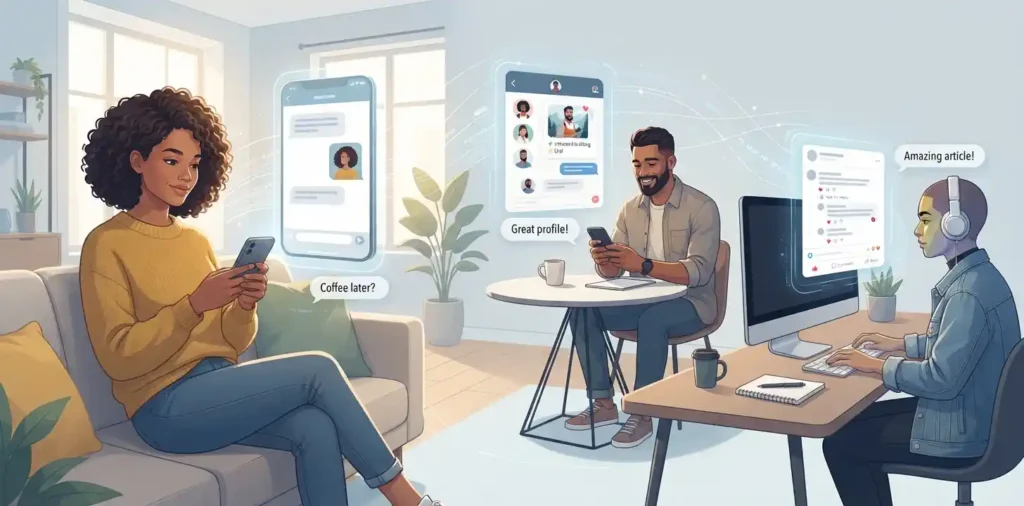
Text Messages
Someone might write:
“Are you looking for an FWB?”
Here, the person is asking whether the other person is interested in a friends-with-benefits arrangement.
DMs
FWB can appear when two people are discussing dating preferences, boundaries, or what they want from each other.
Group Chats
Friends may use FWB while discussing another person’s relationship situation.
Social Media
The abbreviation can appear in posts, comments, memes, or relationship discussions where people are talking about casual relationships.
Dating Conversations
FWB is especially relevant when someone wants to distinguish a casual physical relationship from conventional dating or a committed partnership.
Because it is adult relationship slang, FWB is not appropriate for professional emails, formal writing, or most workplace communication.
FWB in Different Contexts
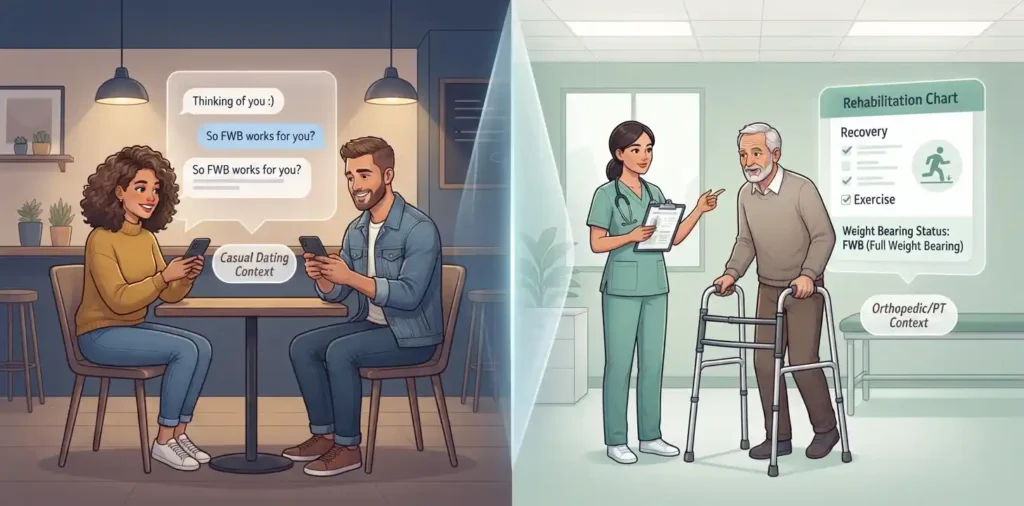
The abbreviation itself normally keeps the same meaning, but the intent behind it can change with the conversation.
From a Friend
If a friend says, “We’re FWB now,” they are usually describing their relationship with another person rather than making a romantic statement to you.
From a Guy
If a guy asks, “Would you be interested in FWB?” he is generally asking about a friends-with-benefits arrangement. The abbreviation alone does not prove that he has romantic feelings.
From a Girl
The meaning is the same if a girl uses FWB. Gender does not change what the abbreviation stands for.
From a Crush
If a crush mentions FWB, the important question is what they are actually proposing. FWB generally points toward a casual physical arrangement rather than automatically meaning they want a committed relationship.
In Dating
FWB usually distinguishes a casual physical arrangement from traditional dating. However, the people involved may define their boundaries differently.
In a Relationship
If someone says, “We started as FWB,” they may be describing how their relationship began. It does not necessarily mean they are still FWB.
In a Group Chat
Friends might use FWB while discussing whether two people are dating, hooking up, or simply friends. In this setting, context is especially important because people may be speculating rather than describing a confirmed relationship.
In Social Media Comments
FWB can be used casually when people discuss dating, relationships, or someone else’s relationship status. A comment containing FWB does not necessarily establish what is actually happening between two people.
Real Chat Examples
Here are realistic ways FWB can appear in everyday conversations:
- “Are you looking for a relationship or FWB?”
→ Asking whether someone wants something serious or casual. - “We’re not dating. We’re just FWB.”
→ Describing a casual relationship arrangement. - “He told me he only wants FWB.”
→ Saying that he does not want a traditional committed relationship. - “Would you ever consider being FWB?”
→ Asking whether someone would consider that type of relationship. - “I thought we were FWB, not dating.”
→ Clarifying the relationship expectations. - “She said she’s not interested in FWB.”
→ Explaining that she does not want that arrangement. - “Are they together or FWB?”
→ Asking whether two people are officially dating or have a casual arrangement. - “We’re friends first, but we’re also FWB.”
→ Describing friendship combined with physical intimacy. - “I don’t think FWB would work for me.”
→ Saying that the arrangement does not fit someone’s preferences. - “He asked if I’d be okay with FWB.”
→ Reporting a conversation about a possible casual arrangement. - “We’re keeping things FWB for now.”
→ Saying they are maintaining a casual arrangement. - “I’m not looking for anything serious, maybe FWB.”
→ Expressing a preference for something casual. - “Is FWB the same as dating?”
→ Asking whether the two relationship types are equivalent. - “My friend is worried her FWB is catching feelings.”
→ Discussing possible emotional changes in the arrangement. - “We started as FWB, but things changed.”
→ Explaining that the relationship developed beyond its original arrangement. - “I’m okay with being friends, but FWB isn’t for me.”
→ Setting a personal boundary. - “He said FWB, but I want an actual relationship.”
→ Showing that the two people want different things. - “They’ve been FWB for a while.”
→ Describing an ongoing casual arrangement.
How to Reply to FWB
Your best response depends on whether you are interested, unsure, or not interested.
Casual Replies
- “What exactly do you mean by FWB?”
- “I’m open to talking about it.”
- “I was thinking something more casual too.”
- “Let’s talk about what we’re both looking for.”
Friendly Replies
- “I value the friendship, but I’m not sure about the benefits part.”
- “I’d rather keep things as friends.”
- “I appreciate you being honest about what you want.”
Funny Replies
- “That’s definitely a three-letter conversation.”
- “Well, that escalated quickly 😂”
- “I think we need a meeting before approving that proposal.”
Neutral Replies
- “What would that look like to you?”
- “I’m not sure. Let me think about it.”
- “I don’t want to assume what you mean.”
- “Can we talk about expectations first?”
Flirty/Relationship Replies
If you’re interested, you can still clarify the arrangement before agreeing:
- “Maybe, but let’s make sure we’re on the same page.”
- “I’m interested in talking about it.”
- “I’m open to it if we agree on what it means for both of us.”
A clear question is often better than trying to interpret the abbreviation by itself.
What Tone Does FWB Have?
FWB is casual, informal, and relationship-focused. It can also sound direct because it labels a potentially sensitive relationship arrangement in just three letters.
Depending on the conversation, FWB can sound:
- Casual — when discussing dating preferences
- Direct — when someone is clearly proposing the arrangement
- Personal — because it concerns intimacy and relationships
- Playful — when used jokingly among friends
- Neutral — when simply describing someone’s relationship status
- Context-dependent — when the surrounding conversation changes the emotional tone
The abbreviation itself does not prove that someone is flirting. The surrounding messages and relationship between the people matter more.
Is FWB Rude or Offensive?
FWB is not inherently a rude or offensive abbreviation, but it refers to an adult sexual relationship, so it may be inappropriate in some settings.
It can be fine in:
- Private conversations between adults
- Dating discussions
- Relationship conversations
- Casual social-media discussions
- Informal messages where the topic is relevant
It is generally unsuitable for:
- Professional emails
- Workplace communication
- Formal writing
- School assignments
- Business documents
If someone uses FWB in a conversation, the term itself is not necessarily insulting. Whether the message feels disrespectful depends on how the person uses it and whether the other person is comfortable with the topic.
Other Meanings of FWB
Although Friends With Benefits is the meaning most people are looking for when they encounter FWB in texting or dating conversations, the abbreviation has other meanings in specialized contexts.
FWB in Medical Terms
In healthcare, physical therapy, orthopedics, and rehabilitation, FWB can mean “Full Weight Bearing.” It describes a situation where a person is permitted to place full body weight on an affected limb, according to their healthcare instructions.
For example:
“The patient is now FWB.”
In a medical record, this clearly does not mean “friends with benefits.”
The surrounding context is the key distinction.
FWB in Other Specialized Contexts
FWB can also appear as an abbreviation or code in specific organizations, systems, or industries. These meanings are much less relevant to ordinary texting.
If you see FWB in a personal text, dating conversation, or social-media discussion, “Friends With Benefits” is normally the interpretation to consider first.
Common Mistakes About FWB
Assuming FWB Means Dating
FWB does not automatically mean two people are officially dating. The term usually describes a casual arrangement that is different from a conventional committed relationship.
Assuming FWB Means No Feelings
The abbreviation describes the arrangement, not every emotion involved. People can develop feelings even when an arrangement begins casually.
Assuming FWB Means Exclusivity
FWB by itself does not establish whether the people involved are exclusive. That is something the individuals need to define.
Assuming FWB Always Means the Same Boundaries
Different people can use the term differently. Expectations about communication, exclusivity, friendship, and the future can vary.
Assuming FWB Is Always a Hookup
FWB and a hookup are related concepts, but they are not identical. FWB generally emphasizes an ongoing friendship or connection alongside physical intimacy.
Assuming the Slang Proves Romantic Interest
If someone uses FWB, you should not automatically conclude that they want a romantic relationship. The term generally points to a casual arrangement, while individual feelings require more context.
FWB and Related Slang
| Term | Meaning | Common Use |
|---|---|---|
| FWB | Friends With Benefits | Friendship combined with physical intimacy |
| NSA | No Strings Attached | Casual relationship with an emphasis on minimal commitment |
| Hookup | Casual sexual encounter or relationship | Informal dating and sexual conversations |
| Situationship | An undefined romantic or dating relationship | Describing unclear relationship status |
| DTF | Down to Fuck | Directly expressing willingness for sex |
These terms overlap, but they are not interchangeable. FWB specifically emphasizes the friendship component, while other terms can describe casual physical or romantic situations without that same friendship foundation.
People Also Ask About FWB
Does FWB mean friends with benefits?
Yes. In texting and relationship conversations, FWB usually stands for Friends With Benefits, meaning friends who also have a casual physical or sexual relationship without a traditional romantic commitment.
Does FWB mean dating?
Not necessarily. FWB usually describes a casual relationship that is distinct from conventional dating, although individual people can define their arrangement differently.
Does FWB mean no feelings?
No. FWB describes the type of relationship, not whether either person has emotions. Romantic feelings can develop even when two people initially agree to keep things casual.
Is FWB the same as a hookup?
Not exactly. A hookup can be a one-time or casual sexual encounter without an established friendship, while FWB generally involves an ongoing friendship or connection.
What does FWB mean on a dating app?
On a dating app, FWB usually means that someone is interested in a friends-with-benefits arrangement rather than a traditional committed relationship. Their exact expectations should be clarified directly.
Can FWB turn into a relationship?
It can, but FWB does not promise that an arrangement will become a romantic relationship. What happens next depends on the people involved and how their feelings and expectations develop.
What does FWB mean from a guy or girl?
The meaning of FWB does not change based on whether a guy or girl uses it. In both cases, it normally means Friends With Benefits. The person’s intentions have to be understood from the broader conversation.
What does FWB mean medically?
In medical and rehabilitation contexts, FWB commonly means Full Weight Bearing. If you see it in a medical note rather than a personal chat, the medical meaning is the relevant one.
Conclusion
FWB in text usually means Friends With Benefits, an informal term for a friendship that also includes physical or sexual intimacy without necessarily being a traditional committed romantic relationship. It is common in personal and dating conversations and can have different boundaries depending on the people involved.
The term is casual and adult-oriented, so it is not appropriate for most professional or formal communication. In medical contexts, FWB can instead mean Full Weight Bearing, making context important when interpreting the abbreviation.

Michael Anderson writes pun and joke articles built around clever wordplay, covering food, animals, seasons, technology, entertainment, and trending topics. Across 3.5 years of experience, he has refined punchlines by comparing wording, shaping joke collections, and polishing phrasing for clarity and flow. His work focuses on keeping each pun fresh, well-structured, and suited to its theme.